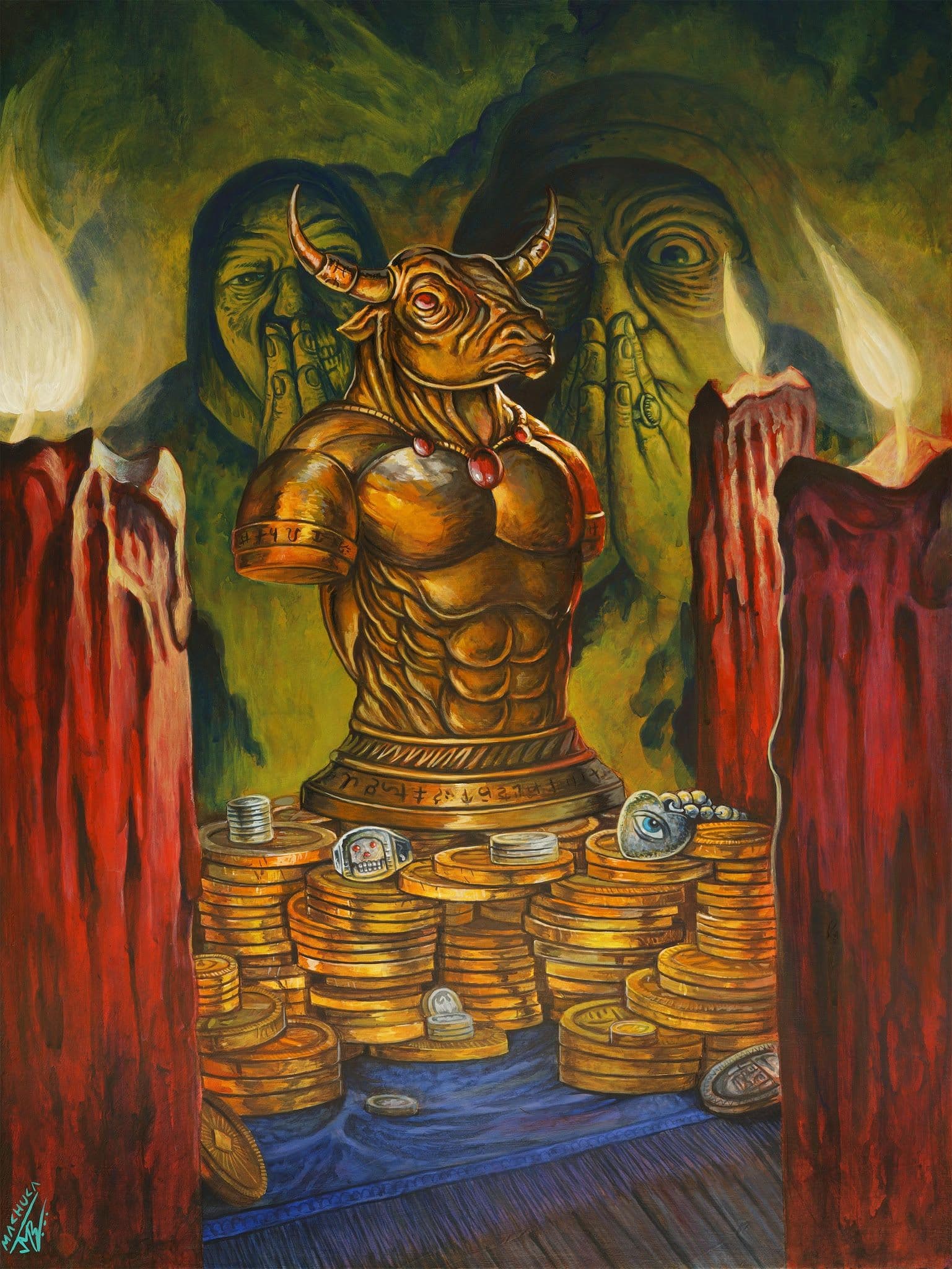

More than 40 original paintings, interviews with three artists and five collectors, and one weekend in Las Vegas offered a glimpse into the people and artwork shaping the Sorcery art community.
A Moment in the Realm
Original Sorcery artwork is usually scattered. One painting hangs in a collector’s home. Another is wrapped in plastic in a closet, some sitting in artist’s studios, or in transit between owners. Most people who play Sorcery will never stand in front of the original painting behind one of their favorite cards.
At the Beasts of the Bay Fall Classic in Las Vegas, that changed.
More than 40 original paintings by 18 artists were brought together in a gallery assembled by 13 collectors from across the country. It offered an opportunity to see the work beyond the borders of the cards and, perhaps more importantly, to see how the people who create and collect that work think about it. That was the idea behind this article.


Upon entering the production area at Beer Zombies Brewery, attendees noticed Sorcery original art mounted on racks, each with their own placard describing the piece and some with quotes from the artist.
Three Sorcery artists were in attendance too: Brian Smith, Juan Machuca and Lindsey Crummett. The art gallery was one piece of a larger weekend of tournaments, ad-hoc drafting, evening artist discussions, a painting class, fully catered meals, a nacho stand, and the usual conversations that happen when Sorcery players get together.

Over the weekend I asked the artists and collectors three key things: what first drew them to Sorcery’s art, what an original shows that a card can’t, and what it’s like to see so many in one place and share the camaraderie with other collectors.

From Cards to Paintings: A Slippery Slope
For many collectors, the path to original Sorcery art starts with the cards.
Henry Cho grew up loving art and collecting early Magic cards. As a kid he sketched, visited museums and followed fantasy artists. When he first came across Sorcery, it brought some of that feeling back. “I was immediately enamored by the art,” he said.
For others, the connection was less immediate. AlphaVolcanicIsland backed Sorcery on Kickstarter and was initially more interested in the game than the artwork. What changed his mind was hearing the artists talk about the meaning behind their work. “It actually means a lot to me, way more than just looking at pretty pictures,” he explained.

Henry with Sorcery artist Juan Machuca.
Jared Miller took yet another route. As an Old School Magic player and tournament organizer in Colorado, he had always known original art existed but never imagined owning any.
“We never had this opportunity when we were growing up. We were just trying to buy cards. We didn’t have the income to buy the original pieces. We didn’t even know that thing was a thing.”
Sorcery changed that. He bought his first Sorcery original after the Gothic set was released. “It started with the Returned King,” Jared said. “Once I did that, it kind of spiraled into what you see today.”

Jared with Sorcery artist Brian Smith holding his Returned King original.
For Neil, a lead organizer with the Beasts of the Bay, part of the appeal was that “Sorcery artwork was attainable. Coming from old school Magic, I was never going to be able to afford early Magic paintings, but these [points to Sorcery paintings] were approachable. You get something that looks a little bit more modern anyway.”
A Collectors’ Priority
The collectors who brought Sorcery art to Las Vegas came from all over the country, and they collect differently too. Some follow particular artists, while others chase themes, card rarities or artistic styles.
Tommy’s collection has grown around water themes. He got into collecting by buying a painting on a cruise: a pirate ship and a giant sea creature rising from the depths. At the Las Vegas gallery, the piece he was most excited to show was Peculiar Port, which drew him in with its colors and the detail and world building packed into the scene.

Tommy and Juan taking a photo with his latest purchase!
For Jared, the chase is part of the appeal. Finding a painting, talking with artists and other collectors, and learning the history behind a piece are all also part of it.
“The relationship building aspect of it and the search for things is different and I've found it very enjoyable. So it's been a nice change of pace from just TCGs.”
He brought two paintings to show at the event. Cranky Overseer by Lindsey Crummett impressed him even more in person than it had online. Lord of Greed by Severine Pineaux came with a story: Jared had recently traveled overseas to meet up with her and acquire it in person, and “so it has a bit of a personal story behind it…that and there’s interesting history with EC on a kind of back and forth with this piece”.
What hooked Henry the most is the artist’s hand in the work. Brush strokes, texture, physical depth and the nostalgia of fantasy art are all part of it. A painting class at the event pushed that further. After watching Lindsey work through a painting, then comparing her finished piece with the attempts made by participants, he came away with a new respect for the skill involved.
AlphaVolcanicIsland liked that Sorcery isn’t defined by a single visual style. There is room for very different approaches, which gives collectors more ways to find something that speaks to them. A favorite piece of his, Troubled Town by Pedro Ferreira, drew him with its fantasy setting and the sense that more is happening in the scene than you first notice.


Lindsey's sketch over the two hour class in the middle, APs on either side.
Meet the Artists
Standing in the gallery, artists had an opportunity to see their work in a way that rarely happens, and was the first time all three had seen such a gathering of Sorcery originals.
For Brian Smith, one of the more interesting discoveries was that his paintings can contain connections to one another that aren't immediately obvious.

The back side of Brian Smith's Endless Fence painting.
While observing his Whirling Blades painting, Brian remembered an issue he faced. “I ran out of room at the top and I needed to add like an extra 6 inches…so I must have just laid a new panel on top of the whirling blades to add that extension [for the photo].” Years later, that same panel became the back of Endless Fence. He had forgotten the connection until he saw the two paintings together in Las Vegas.

Kevin with one of his favorite originals, promo Pudge Butcher by Brian Smith.
Brian also intentionally creates connections across his work. “I like the idea that maybe little elements of certain pieces end up as elements in other ones.” he said.
His approach to Sorcery has changed as well, having worked on Alpha, Beta and Gothic sets. “I definitely have a better sense now for how the painting will look as a card,” he said. That means thinking about composition, brightness, the card frame and even how the artwork communicates the card’s effect, which is a different problem from making a painting that works on its own, Brian noted.
Juan Machuca considers himself a storyteller as much as a painter. His paintings often hold multiple characters and smaller stories that reward a closer look. “You’re looking at a tiny world and you’re watching all the little things happening in that world,” he said. At card size, many of those details are easy to miss. On a full-size painting, they’re the point.
Seeing the other artists’ work was new to him too. “This is the first time I have seen everyone’s work, like this amount and this close,” he said. He spent a lot of time looking at the paintings from the side and from below, studying the surfaces.

“You can still see the way the painter knows how to master their medium, the different techniques that they have, the versatility and variety from all the artists.”
Lindsey Crummett thinks of a Sorcery painting as two compositions in one: the painting itself, which has to work as a complete image, and the version that exists once the card’s text boxes are laid over it. “It’s a really cool challenge to think about the composition as almost two different pieces,” she explained.
That has changed how she handles color and composition. Feedback on pieces for Erik’s Curiosa, such as with Coy Nixie, also got her thinking about how color helps a card stand out when players are flipping through a deck.

She had never been to an exhibition like this one, and it changed how she saw work she already knew. “Everything is different when it’s off the card,” she said. “Whether it’s a shift in saturation or color or just details that you never notice.”
Seeing the Gallery in Person
Forty-plus paintings look very different hanging together than they do as individual images on a screen. Juan said he could see textures and colors he hadn’t noticed on the cards, or even in the framed art images on thepaintedrealm.com. Brian had been to plenty of Sorcery events, but never one with this many originals in one place. Four of his were on display.
For Neil, the number mattered less than how the art got there. Collectors traveled considerable distances, and most flew with their paintings from places including Colorado, Seattle, Los Angeles and Pennsylvania. Most of these works simply aren’t available to be seen in person. Neil pointed to Mirage by Drew Tucker as an example.

“Nobody's going to see Mirage unless I bring it out to an event. So that just adds to the uniqueness of any event where you can do something like this.”
Collectors got to see pieces they had known only from photographs, artists got to see their peers’ work, and players who had never thought much about original art could walk through the paintings behind the cards they play. People compared favorites, artists pointed out details, and collectors explained why certain pieces mattered to them.
What’s Your Favorite?
The question of which painting you’d take home turned out to be revealing. Asked to name a favorite piece that wasn’t theirs, a variety were selected, but two paintings kept coming up. Realm Eater and Giant Shark.
- Brian Smith went straight to Drew Tucker’s Mirage, then Lindsey Crummett’s Cold Iron Rod and Alan Pollack’s Giant Shark.
- Lindsey Crummett also chose Giant Shark, saying its colors and atmosphere drew her into the physical piece.
- Juan Machuca chose Realm Eater for its colors and textures, and for the connection he already felt with the artist’s work.
- Jared went back and forth between Realm Eater and Giant Shark, citing the framing, colors and visual impact.
- Tommy also would have taken Realm Eater, saying the purples and greens really appealed to him.
- Henry chose City of Glass for its architecture, its warm clouds and the way the painting made him feel.
- Neil chose Peculiar Port, calling it one of the most distinctive pieces in the room for its composition, activity and world building.
A Community Still Taking Shape
The original art community around Sorcery is still small and in its infancy, which may be part of what makes it appealing. Some collectors bring decades of trading card game and art collecting experience. Others are discovering original art for the first time.
Lindsey described the people behind Beasts of the Bay as unusually committed to Sorcery. She agreed with my term for them, “hardcore casuals.” “They’re chill, but they’re really deep into Sorcery and organize very unique events,” she said.
AlphaVolcanicIsland made a similar point: the community is big enough to bring together people from many backgrounds, but not so big that the personal side disappears. Henry said much the same. He had come to Sorcery more as a collector than a player, but getting to know people across the community deepened his feel for both the game and its art.
Art gives people a reason to talk to one another. Who painted this? What’s the backstory? Who owns it? What do you like about it? Those conversations wouldn’t happen over the cards alone.
The Las Vegas gallery came out of exactly that. It wasn’t one person’s collection on display. It was a group of collectors deciding to bring their paintings together for others to enjoy them. For a weekend, private collections became something communal.

A few TPR members with the artists in the gallery.
State of the Realm
This experience offered an unusual snapshot of the Sorcery art scene in 2026.
There is no single reason people collect Sorcery art, and no single kind of painting that defines what they want to own. But the appreciation for the physical artwork, the artists who make it, and the community around it was easy to see.
The cards are how most people meet Sorcery’s art. For the collectors in Las Vegas, the paintings are the originals behind the cards, pieces of the game’s history, and often objects with stories that continue long after they leave the artist’s studio.
For a weekend, those stories were all hanging in one room. That was the State of the Realm.
A huge thank you to Neil for helping coordinate the art gallery and for providing such high-end infrastructure for the event. Jared Miller probably said it best when explaining what makes the Beasts of the Bay special:
“The lengths they go to from providing snacks and a nacho bar to all the different kinds of choose your own adventure events you can attend is very unique. It’s kind of a once in a lifetime type of opportunity because…you get a ton of value within that ticket. You get swag, you get meals, you get infinite free draft, you get to spend more intimate time and meals with multiple artists and people from across the world, you get to see a display of over 40 artworks. The Beasts have a huge passion for Sorcery and event organization. Frankly, I don’t know if it can be matched. So for me, all that work and effort that goes into the event is really what makes it special.”